

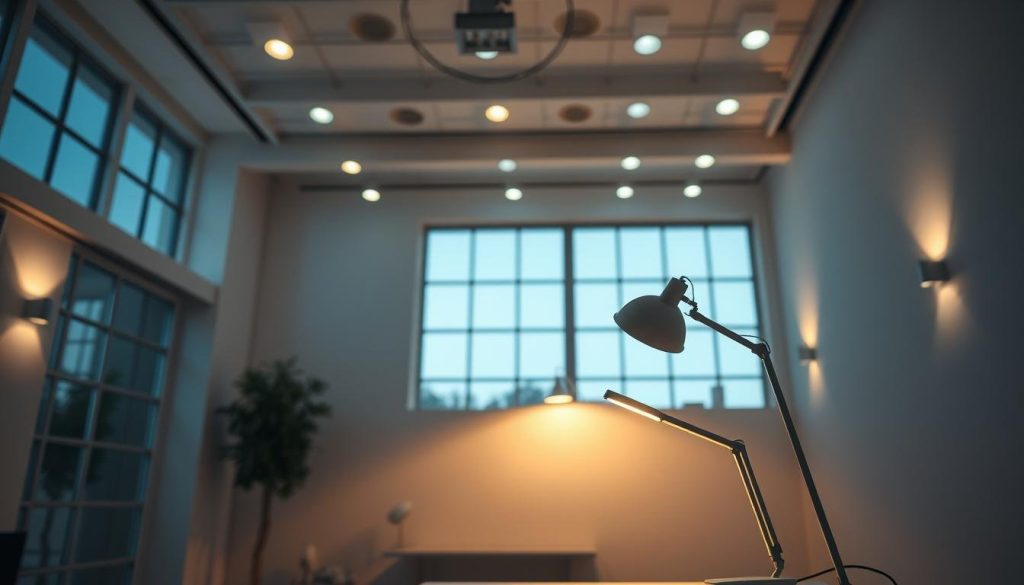
Don’t let dim, unflattering lighting hold back your home’s potential. Effective lighting isn’t just about being bright. It’s about making spaces feel welcoming and useful. With LED bulbs lasting 25x longer than old bulbs, it’s time to change how you light your home.
Imagine a kitchen where task lighting makes you more productive. Or a bedroom with warm 2700K bulbs that relax you. Using just one overhead light makes rooms feel dull. Smart lighting cuts energy costs, reduces eye strain, and fights off seasonal blues. Let’s make your space better with lighting that works as hard as you do.
Key Takeaways
- LEDs slash energy use by 90% and last 25x longer than traditional bulbs.
- Layering ambient, task, and accent lighting boosts both mood and room usability.
- Warm 2700K tones create cozy living areas while 4000K+ bulbs sharpen task zones like kitchens.
- Smart systems like Philips Hue let you control light with voice or apps, adding security features too.
- Strategic placement avoids glare, while techniques like wall washing and uplighting expand perceived space by up to 40%.
Understanding the Importance of Lighting in Your Home
Think your home’s vibe is all about furniture? Think again. Lighting is the secret sauce that makes spaces feel alive—or falls flat. Poor choices can drain energy, strain eyes, and even shrink a room’s perceived size. Let’s cut through the confusion. Lighting design principles are the blueprint to avoid these pitfalls.
Why Lighting Matters
Without proper layering of light types, your home loses its potential. 80% of daily tasks depend on ambient lighting, yet 40% of homeowners neglect this base layer. Fact: 60% of home offices suffer from inadequate task lighting, causing eye strain. Professional lighting strategies fix this by balancing ambient for comfort, task for focus, and accent for style.

The Impact on Mood and Ambiance
“Lighting is the architecture of atmosphere.” — Lighting Research Center
Warm tones boost happiness by 20%, while dim rooms drain energy. 75% of homeowners admit well-lit art makes them happier. Natural light slashes depressive feelings by 25%, yet only 30% of spaces use it effectively. Layering light types creates spaces that feel 30% larger and 20% more inviting.
Ready to upgrade? Start by auditing your fixtures. Swap harsh overheads lights for layered solutions. Your brain—and your guests—will notice the difference. Final Cut Multimedia helps brands tell stories through video. Let us help you craft spaces that speak volumes.
Types of Lighting Techniques

Don’t let bad lighting ruin your space. Learn about effective lighting techniques. There are three main types: task, ambient, and accent. Let’s explore them so you can fix your lighting fast.
Task Lighting
Task lighting is key. It includes under-cabinet lights, desk lamps, and reading lights. These lights help you see clearly while working or reading.
Ambient Lighting
Ambient lighting is the base. It includes ceiling lights, chandeliers, and recessed lights. It makes sure every corner is well-lit.
Accent Lighting
Accent lights make things special. They are used for track lights, LED strips, and picture lights. They highlight important areas.
| Type | Purpose | Examples |
|---|---|---|
| Task Lighting | Focus on activities | Desk lamps, under-cabinet lights |
| Ambient Lighting | General room illumination | Chandeliers, recessed lights |
| Accent Lighting | Highlight focal points | Track lights, LED strips |
Quick lighting tips: Check your space. Do you have all three types? Missing one? You’re missing out. Act now to improve your lighting.
Still unsure? Contact Final Cut Multimedia. Our experts can help. Don’t settle for poor lighting. Call us today.
Choosing the Right Fixtures for Your Space
Your home’s lighting fixtures are key to its function and feel. They can change any room, from bright kitchens to cozy bedrooms. Don’t let bad fixtures or placement stop you. These 
First, think about what your space needs. Living rooms need warm overhead lights and task lights for reading. Kitchens should have cool, bright LEDs for prep and warm dimmable lights for dining. Bathrooms need bright vanity lights and soft tones for tubs.
What to Consider for Each Room
- Kitchens: Use LED under-cabinet lights for prep areas. 8’ ceilings? Choose flush mounts to avoid clutter.
- Bedrooms: Mix warm tones with dimmers. Add table lamps for reading at night.
- Bathrooms: Install vanity lights with adjustable dimming. Warm tones around tubs make it spa-like.
- Offices: Pick glare-free track lighting. LED panels help reduce eye strain during long work hours.
Popular Fixture Styles
| Style | Best For | Pro Tip |
|---|---|---|
| Pendant Clusters | Kitchens, dining areas | Layer over islands for task + ambient light |
| Architectural Sconces | Entryways | Add drama without overwhelming small spaces |
| Track Lighting | Offices, living rooms | Adjustable beams for multitasking |
| Modern Chandeliers | Dining rooms | Pair with dimmers for mood shifts |
Still unsure? Optimal lighting solutions begin with knowing your space’s purpose. Mix metals with care—polished nickel warms, chrome cools. Reviews and samples help avoid surprises. Ready to update your fixtures? Your home needs lighting that works as hard as you do.
Layering Your Lighting Effectively
Still using just one overhead light? Professional lighting strategies say it’s time for more. Layering makes your space comfy and useful. It’s not just about looks.

Combining Different Lighting Types
Think of your space as a canvas. Begin with creative lighting methods that blend:
- Ambient: Overhead lights or recessed lighting for basic light.
- Task: Under-cabinet LEDs for kitchens or desk lamps for reading.
- Accent: LED strips under cabinets or wall sconces for art or architecture.
| Type | Purpose | Example Fixtures |
|---|---|---|
| Ambient | General room light | Recessed lights, chandeliers |
| Task | Focus on work areas | Led strip lights, desk lamps |
| Accent | Highlight features | Track lights, picture lights |
The Benefits of Layering
When you use professional lighting strategies, you get:
- Mood boost: 20% more comfort and productivity (studies show).
- Safety: 25% fewer accidents with task lighting in kitchens.
- Efficiency: Save 30% on energy with dimmers.
“The right layers turn a room from functional to unforgettable.” – Interior Design Institute
Begin with small changes. Replace that single ceiling light with table lamps and under-cabinet LEDs. Your space and eyes will be happier.
Utilizing Natural Light
Start your lighting strategy with the sun’s free energy. Natural light isn’t just pretty—it’s a cost-cutting, mood-boosting powerhouse. Over 80% of viewers prefer videos with natural light, and every room deserves a second chance to shine. Let’s make sunlight work harder for you.

Techniques for Maximizing Sunlight
Small changes yield big results. Try these today:
- Place mirrors opposite windows to double your light spread.
- Swap heavy drapes for translucent roller shades—privacy without blocking rays.
- Move bulky furniture away from windows to keep light paths clear.
- Add solar tubes for rooms without windows; they cost as little as $500.
Benefits of Natural Light
Golden hour’s warm glow isn’t just for photographers. Natural light:
- Cuts energy bills by reducing artificial light use.
- Boosts vitamin D and productivity in workspaces.
- Creates free, dynamic lighting for videos without harsh shadows.
| Solution | Cost | Key Advantage |
|---|---|---|
| Solar tubes | $500+ | Easy installation, ideal for retrofits |
| South-facing windows | $600-$1000/ window | Passive solar heating + shorter payback time |
| Reflectors | $20-$50 | Instant light diffusion for photography |
Act now. Your walls aren’t too dark, and your budget isn’t too tight. A quick mirror placement or window clean could transform your space. Let natural light be your optimal lighting solution’s backbone.
Smart Lighting Solutions

Smart lighting is more than a luxury. It’s a game-changer for homes and businesses. It lets you save energy, boost security, and customize your space with just a switch. Smart systems combine energy-efficient lighting techniques with professional lighting strategies. This makes your space smarter overnight. Here’s how it works:
Benefits of Smart Lighting
- Reduce energy costs by up to 30% with automated scheduling and occupancy sensors.
- Boost security with motion sensors and remote control—turn lights on/off from anywhere.
- Customize color and brightness to match moods, events, or circadian rhythms.
- Enjoy voice control via Alexa, Google Assistant, or Apple Home for effortless adjustments.
Best Smart Lighting Products
| Product | Key Features | Energy Efficiency |
|---|---|---|
| Linkind Matter Smart RGBTW Bulb | 1600 lumens, 14W (equivalent 100W incandescent) | 80% more efficient than traditional bulbs |
| Linkind Wireless Bluetooth Hub | Controls 32 devices, 98ft-40m range | Saves 20-30% via scheduling |
| Linkind Dimmer Switch | Supports 200W loads, dimming control | Cuts energy use by adjusting brightness |
Start small with a smart bulb or hub. Add occupancy sensors or voice assistants. Each upgrade makes your space more efficient, secure, and tailored to you. Act now—smart lighting pays off fast. With 80% energy savings and seamless control, there’s no reason to wait.
Ready to transform your space? Check out Linkind’s RGBTW Bulb or the Wireless Hub. Got questions? Our experts at Final Cut Multimedia can help—call us today to future-proof your lighting strategy. Your energy bills—and your space—will thank you.
Color Temperature and Its Effects
Choosing the right color temperature is key to balancing function and comfort in your space. Lighting design principles use the Kelvin scale to show warmth or coolness in bulbs. Let’s see how this affects your indoor and outdoor lighting ideas.

Exposure to blue light after sunset can disrupt sleep cycles, while warm light supports relaxation.
Understanding Color Temperature
Color temperature is measured in Kelvin (K):
- 2700K-3000K: Warm, cozy light for relaxation (living rooms, bedrooms)
- 3500K-4100K: Neutral for task areas (kitchens, home offices)
- 5000K-6500K: Cool, bright light for focus (workshops, retail spaces)
| Room | Color Temperature (K) | Why It Works |
|---|---|---|
| Bedroom | 2700K-3000K | Reduces melatonin disruption |
| Kitchen | 3000K-4000K | Clarifies details without glare |
| Outdoor pathways | 3000K | Safe visibility without harshness |
Choosing the Right Temperature for Each Room
Don’t let mismatched bulbs ruin your space. For indoor and outdoor lighting ideas, follow these rules:
- Living rooms: 2700K-3000K (TCP’s Anew Lighting offers 2850K bulbs with no blue light spikes)
- Home gyms: 4000K+ for energy
- Outdoor entertaining areas: 3000K with dimmable options for flexibility
Still stuck? Our team at Final Cut Multimedia helps businesses craft spaces that engage audiences—whether through lighting or video storytelling. Your next move? Audit your current bulbs. Swapping to the wrong temp could cost you comfort and productivity. Prioritize your space’s purpose and adjust accordingly.
Lighting Control Options
Take control of your space with lighting systems that adapt to your needs. Lighting control options turn static setups into dynamic solutions. They mix creative lighting methods with energy-efficient lighting techniques. Whether you’re boosting productivity or saving energy, these tools make every light work smarter.

Dimmers and Their Benefits
Dimmers let you adjust brightness for any moment. Key points:
- Dimming cuts energy use by lowering wattage and light output.
- LEDs need “dimmable” labels—check packaging to avoid damage.
- Save 24–38% energy by dimming, per LBNL studies.
- Warm dimmed tones boost relaxation, while brighter settings energize daytime tasks.
Using Smart Controls for Flexibility
Smart systems adapt to your life. Top options include:
- Occupancy sensors: Auto-shutoff saves 24% energy.
- Daylight harvesting: Photosensors cut usage by 28% when natural light is available.
- Task tuning: Adjust brightness for work zones, saving 36% energy (IES).
- Wireless controls: Ideal for retrofitting without rewiring.
| Control Type | Energy Savings | Key Features |
|---|---|---|
| Dimming | 24–38% | Mood customization + energy cut |
| Occupancy | 24% | Auto ON/OFF for unoccupied spaces |
| Daylight | 28% | Automates based on natural light levels |
| Task Tuning | 36% | Custom light levels for specific tasks |
Don’t settle for static lighting. Lighting control options aren’t just upgrades—they’re essential. They make spaces work harder and cost less. Ready to rethink your lighting strategy? Start small with dimmers or dive into smart systems. Your energy bills—and comfort—will thank you.
Professional Assistance and Consultation
Your lighting journey starts with getting it right. When DIY methods fail, experts help. They make sure every bulb and fixture works well.
When to Call an Expert
Experts are best for complex lighting needs. They help with big projects, tricky spaces, and more. Over 90% of designers say lighting is key to success.
Don’t risk spending too much or not enough. Call pros for precision in looks, energy use, and function.
Contact Us at 704-491-1283 for More Information
Start with a quick call for better lighting. We show how to save up to 75% with smart choices. We plan for your living room or office.
Over 85% of clients find their goals clearer after talking to us. Don’t let bad lighting waste your time or money. Get a free review today. Your brighter future is just a call away.
FAQ
What are effective lighting techniques for my home?
Good lighting mixes task, ambient, and accent lights. This mix makes your home work well and look good. It lets you change your space to fit your needs.
How does lighting affect mood and ambiance?
Lighting sets the mood and feel of a room. The right light can make you feel calm and sleep better. But bad light can make you feel uncomfortable.
What should I consider when choosing lighting fixtures?
Think about what each room needs in terms of light. Look at style and how light spreads. Pick fixtures that look good and work well.
What is the importance of layering lighting?
Layering lights adds depth and interest. It gets rid of shadows and lets you light up different areas. This makes your space look better.
How can I maximize natural light in my home?
Use mirrors to reflect light and pick window treatments that let in light. Place furniture to let sunlight in. This makes your home brighter and more welcoming.
What are the benefits of smart lighting solutions?
Smart lights let you change the mood and save energy. They adjust automatically and give you control. They make your home better and future-proof.
How does color temperature impact my living spaces?
Color temperature affects how you feel and the look of a room. Warm colors relax you, while cool colors wake you up. Knowing this helps you choose the right bulbs for each room.
What are lighting control options available to me?
You can use dimmers, smart controls, or voice assistants. These let you adjust light levels for different activities. They also save energy.
When should I consider contacting a lighting professional?
Get a lighting expert for big changes, tricky homes, or special lighting needs. They ensure your lighting is both useful and beautiful.